
--- title: >- 3D Printing Companies in India: 12 Capabilities Engineering Teams Should Compare description: >- Engineering teams should compare 3D printing service bureaus in India on in-house process range, CAD review depth, material guidance, finishing, inspection, communication, confidentiality and delivery discipline — not price alone. date: '2026-08-03' author: Excel Rapidtech Editorial Team coverImage: >- https://excelrapidtech.com/wp-content/uploads/2026/07/6a7040bb28293-1-1568x646.png keyword: >- 3d printing companies india, compare 3d printing services, 3d printing supplier selection, cad review, 3d printing finishing capability, 3d printing service scorecard, sla sls mjf dlp fdm faqs: - q: >- How should I compare 3D printing companies in India? a: >- Compare in-house process range, CAD review, material options and advice, finishing capability, inspection capability, communication, confidentiality, delivery discipline and quote clarity. - q: >- How many suppliers should I shortlist? a: >- Two or three serious suppliers are usually enough if the brief is clear. More options often add noise unless the requirement is unusual. - q: >- Should I choose the lowest quote? a: >- Not automatically. Check what the quote includes and whether the recommended process fits the use application of the part. A low price can become expensive if the part needs rework or fails. - q: >- What makes a supplier easier to work with? a: >- Clear questions, written assumptions, practical process advice, honest trade-offs and reliable handoff support make a supplier easier to work with. metaTitle: 3D Printing Companies in India: 12 Capabiliti ---
Many suppliers list similar words on their websites: rapid prototyping, industrial printing, high quality, fast delivery. Those claims are not enough for a technical shortlist.
The better question is how the supplier handles a real situation. Do they have in-house capability or do they outsource? Do they ask what the part must prove? Do they identify critical interfaces? Do they explain the process trade-off? Do they separate commercial assumptions from engineering assumptions?
This guide works as a vendor shortlisting aid: the 12 capabilities worth comparing, how to use the scorecard, and the red flags that signal a weaker supplier.
Quick Answer
Comparing 3D printing service bureaus in India should not start with price alone. Engineering teams should compare the service bureau's in-house technology and process range, CAD review depth, material options and advice, knowledge of the process, finishing capability, inspection capability, communication, confidentiality and delivery discipline.
The best supplier is the one that helps the part succeed in its actual use case. A low quote on the wrong process is not a saving if the part arrives late, looks unfinished or fails at the assembly, testing or end use application stage.
Why Supplier Comparison Matters
- A low quote on the wrong process is not a saving if the part arrives late, looks unfinished or fails at the assembly, testing or end-use application stage.
- The best supplier is the one that helps the part succeed in its actual use case.
- A strong supplier will ask smart questions and explain the trade-off; a weak supplier will rush to a number without clarifying what the part needs to do.
- Price only helps when the scope is comparable — one quote may include finishing, inspection and shipping, another may only include a raw print.
- Asking what is included, what is optional and what the supplier has assumed prevents many supplier-selection mistakes.
Where Excel Rapidtech Fits
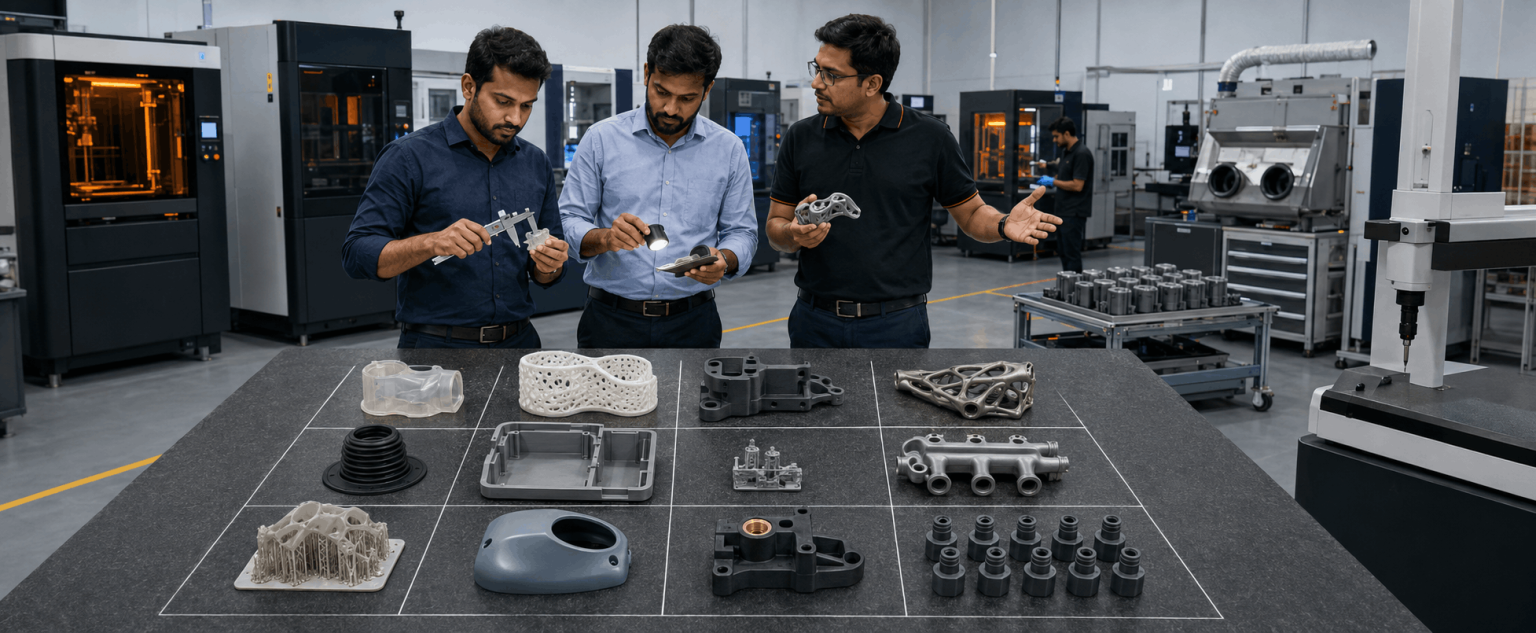
This scorecard is designed to connect to service and infrastructure pages. For teams shortlisting suppliers, Excel Rapidtech's services and infrastructure pages cover the in-house technology and process range this checklist examines — SLA, SLS, MJF, DLP, FDM, metal 3D printing, vacuum casting and CNC support.
Suggested next step: share your CAD file and requirements to compare the right process, material and finishing route before requesting a final quote.
Comparison
| Capability | What to check | Why it matters |
|---|---|---|
| 1. CAD review | Can the team flag thin walls, weak features and file issues? | To ensure that part features are properly made. |
| 2. Process range | SLA, SLS, MJF, DLP, FDM, metal 3D printing, vacuum casting or CNC support | Keeps the recommendation tied to the use case application. |
| 3. Material guidance | Strength, heat, chemical, flexibility and cosmetic expectations | Reduces wrong-material decisions and failures. |
| 4. Tolerance discussion | Critical dimensions and assembly interfaces | To align quality expectations. |
| 5. Finishing capability | Sanding, painting, smoothening, inserts, threading and assembly | To ensure part finishing is as expected. |
| 6. Inspection discipline | Visual, dimensional and fitment checks where required | Supports engineering confidence and ensures parts are as required. |
| 7. Batch handling | One-off builds, short batches and staged quantities | Helps pilot and low-volume work. |
| 8. Lead-time clarity | Review, build, finishing, inspection and shipping timelines | Prevents unrealistic delivery promises. |
| 9. Communication quality | Written assumptions and clear trade-offs | Makes purchasing decisions clearer. |
| 10. Confidentiality | Basic NDA and file-handling practices | Protects product-development work. |
| 11. Handoff support | Packing, labelling and delivery coordination | Reduces confusion after dispatch. |
| 12. Technical honesty | Ability to say when another route is better | Shows the advice is not machine-led. |
How to Use the Scorecard
Do not score every supplier on a long spreadsheet before sharing a real brief. First, shortlist two or three providers with relevant capability. Then send the same file, quantity, material expectation, finish level and target date to each supplier.
The best comparison comes from how they respond. A strong supplier will ask smart questions and explain the trade-off. A weak supplier will rush to a number without clarifying what the part needs to do.
Step-by-Step Workflow
Start with the part, then compare suppliers on the same brief. What to send for a fair comparison:
- The same CAD file for every supplier
- Expected quantity and future batch possibility
- Material and performance expectations
- Critical dimensions and surfaces
- Finish and post-processing requirements
- Delivery destination and required date
- Any special packing requirement
Common Mistakes to Avoid
- The supplier recommends a process without asking how the part will be used
- Location of production facility not being clearly revealed or visit not allowed – major red flag as this indicates sub-par facility and systems
- The quote does not mention tolerance, inserts, inspection or delivery assumptions
- Every part is pushed toward the same process
- The supplier cannot explain why one material is being recommended
- Revision handling is unclear if the CAD file changes
- The final part does not match the finish level being quoted
Price Still Matters, But It Needs Context
Price is important, especially for repeat quantities. But price only helps when the scope is comparable. One quote may include finishing, inspection and shipping. Another may only include a raw print. Technology and material differences greatly affect the pricing.
Before comparing totals, ask what is included, technology and material considered, what is optional and what the supplier has assumed. This simple step prevents many supplier-selection mistakes.
What to Measure
Score each shortlisted supplier against the 12 capabilities: CAD review, process range, material guidance, tolerance discussion, finishing capability, inspection discipline, batch handling, lead-time clarity, communication quality, confidentiality, handoff support and technical honesty.
A supplier that asks smart questions, explains trade-offs and separates commercial assumptions from engineering assumptions is a stronger partner than one that rushes to a number.
Conclusion
Start with the part, not the supplier brochure. Shortlist two or three suppliers with relevant capability and send each the same brief; then compare how they respond. A strong supplier asks smart questions and explains trade-offs, while a weak supplier rushes to a number. Compare price only after the scope is comparable, and treat missing tolerance, inserts, inspection or delivery assumptions as red flags.
Ready to discuss your part?
FAQs
How should I compare 3D printing companies in India?
Compare in-house process range, CAD review, material options and advice, finishing capability, inspection capability, communication, confidentiality, delivery discipline and quote clarity.
How many suppliers should I shortlist?
Two or three serious suppliers are usually enough if the brief is clear. More options often add noise unless the requirement is unusual.
Should I choose the lowest quote?
Not automatically. Check what the quote includes and whether the recommended process fits the use application of the part. A low price can become expensive if the part needs rework or fails.
What makes a supplier easier to work with?
Clear questions, written assumptions, practical process advice, honest trade-offs and reliable handoff support make a supplier easier to work with.
Related Reading
- Which 3D Printing Technology Should You Choose? A Guide for Engineers
- 3D Printing Services in India: SLA vs SLS vs MJF vs DLP
- 3D Printing Services in India: Cost, Lead Time and RFQ Checklist
- In-House 3D Printing vs a Professional 3D Printing Service: Which Is Better?
- 3D Printing Services in India: Complete Guide to Technologies, Materials and Applications