
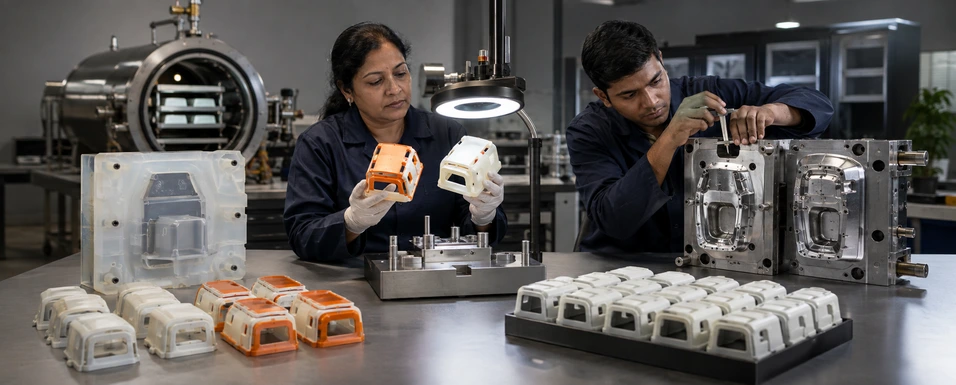
Vacuum casting is serving repeated batches, but the team is uncertain whether continued casting or production tooling is now more economical. The transition must consider design maturity as well as quantity.
This article explains how vacuum casting vs injection moulding should be evaluated from the customer-problem, engineering-decision and commercial-buyer perspectives. It also shows what information should be shared with a professional manufacturing partner so the quotation, process and final part are aligned with the real project objective.
Vacuum casting helps teams obtain multiple similar parts before hard tooling. It can support trials, demonstrations and limited launches. As demand grows and the design stabilises, the economics and technical needs may shift toward injection moulding.
Tooling changes can be expensive. Move toward injection moulding when dimensions, fastening points, wall thickness, assembly and external appearance have been validated. If the team is still making frequent geometry changes, continuing with a flexible low-volume process may reduce risk.
Quick Answer
The decision to move from vacuum casting to injection moulding should be based on design maturity and credible lifetime demand, not an arbitrary part count or one unusually large order. Move when the design is frozen, demand is recurring and forecastable, a specified production-grade material is required and repeatability at larger volumes matters — and only after comparing total economics, including tooling, corrections, rejects and the financial impact of design changes.
Why the Transition Decision Matters
- Vacuum casting supports trials, demonstrations and limited launches before hard tooling is committed.
- As demand grows and the design stabilises, the economics and technical needs may shift toward injection moulding.
- Tooling changes can be expensive, so the move should wait until the design is validated.
- A low part price does not compensate for an expensive tool that must be modified.
- A process selected around a real engineering and commercial objective keeps the quotation, process and final part aligned with the project goal.
Where Excel Rapidtech Fits
Excel Rapidtech can help determine whether the product has completed the validation stages that low-volume prototyping is intended to support. The decision should be based on design readiness and commercial demand rather than an arbitrary part count.
Excel Rapidtech can review the CAD model, application, quantity, material expectation, finish and critical dimensions before recommending a suitable route. The company's wider service structure allows relevant projects to be considered across 3D printing, SLA, SLS, vacuum casting, CNC machining, design support and post-processing rather than being forced into one method.
The recommendation should remain factual and project-specific. Final tolerance, material performance, mould yield, delivery and compliance depend on the approved design, selected material, process plan and documented acceptance criteria. These points should be confirmed during technical review and quotation.
Key Factors
The following factors should be reviewed together. Optimising one in isolation can create a new problem elsewhere in the project.
- Forecast confidence: review forecast confidence, repeat orders, seasonality and the possibility of another design revision. Do not invest in tooling because only one batch is larger than expected.
- Design freeze: move toward injection moulding when dimensions, fastening points, wall thickness, assembly and external appearance have been validated.
- Specific production material: if a certified production material or long-term performance that casting resin cannot represent is required, injection moulding may become necessary earlier. Confirm material data, compliance and operating conditions.
- Repeatability requirement: injection moulding can provide stronger repeatability over larger volumes, but only when the tool and process are correctly developed.
- Total lifetime volume: the relevant question is not only the next order quantity but the expected lifetime quantity.
- Total economics: include tooling, samples, tool corrections, per-part cost, finishing, rejects, inventory and the financial impact of design changes.
- Controlled transition: before full production, approve tool design, first-off samples, material, colour and inspection criteria. Keep the vacuum-cast reference parts and test records so they can support comparison during tool approval.
Comparison
| Decision area | Option or condition A | Option or condition B |
|---|---|---|
| Design status | Still evolving | Frozen and released |
| Demand | Pilot or uncertain | Recurring and forecastable |
| Material | Simulation acceptable | Specified production grade required |
| Economics | Low upfront commitment | Tooling justified by lifetime volume |
| Quality control | Batch-based | Stable repeated production process |
Step-by-Step Workflow
- Define the business decision the part must support. Examples include design approval, fitment validation, customer trial, tooling release or a limited pilot batch.
- Identify the technical risks. Mark interfaces, critical dimensions, loads, environmental exposure, visible surfaces and features that may fail during assembly.
- Select the process around those risks. Compare geometry, material behaviour, quantity, finish and design stability rather than choosing only by familiarity or lowest price.
- Agree on acceptance criteria. State what will be measured, assembled, tested or visually approved before the part is accepted.
- Control revisions and approvals. Use a clear file number, record feedback and freeze the approved version before the next manufacturing stage.
Common Mistakes to Avoid
- Moving to tooling after one unusual order.
- Ignoring possible design revisions.
- Comparing only unit cost.
- Failing to approve first-off moulded samples.
- Discarding prototype test records.
How the Complete Vacuum Casting Workflow Affects the Result
The process begins before resin is poured. CAD review determines whether undercuts, thin walls and trapped regions are suitable. The master pattern establishes geometry and surface quality. Silicone mould planning controls the split, gates and vents. Material preparation, vacuum handling, cure and demoulding then determine whether the copy is complete and stable. Finally, trimming, finishing and inspection convert the casting into an approved part. A weakness at any stage can appear as a dimensional, cosmetic or delivery problem later. Buyers should evaluate the workflow as an integrated chain rather than treating casting as a single machine operation.
Cost and Lead-Time Drivers
Cost is influenced by master-pattern production, surface preparation, mould complexity, number of moulds, resin, colour, finishing, inspection and approved quantity. Lead time is affected by CAD clarification, master approval, silicone curing, trial castings and any rework required before the batch begins. Urgent projects benefit from a complete brief and fast approval process, not from skipping controls. The quotation should state assumptions so both parties understand what will change the price or schedule.
Information to Share with the Service Provider
Provide a STEP file where possible, the required approved quantity, the purpose of the parts, colour and finish expectations, critical dimensions, mating components and the planned test environment. Identify cosmetic faces and areas where flash or a parting line would be unacceptable. State whether the batch is for internal engineering, customer trials, an exhibition or limited sale. This context allows the provider to plan the master, mould and inspection standard around the actual outcome.
How to Evaluate a Vacuum Casting Quotation
Check whether the quotation includes the master, master finishing, silicone moulds, trial pieces, approved parts, colour, post-processing and dimensional inspection. Ask how mould replacement will be handled if the first mould does not support the whole batch. Confirm what constitutes an acceptable part and how rejected pieces affect quantity. A lower price can reflect fewer finishing or inspection steps, so compare scope rather than only totals.
What to Measure
- Forecast confidence defined in measurable terms and linked to the intended test, assembly or production decision.
- Design freeze status confirmed before tooling.
- Specific production material requirement confirmed, with material data, compliance and operating conditions.
- Repeatability requirement defined in measurable terms.
- Total lifetime volume established.
- First-off moulded samples approved.
- Vacuum-cast reference parts and test records retained for comparison during tool approval.
Conclusion
The right use of vacuum casting vs injection moulding begins with a clearly defined problem and ends with an evidence-based manufacturing decision. Buyers should connect design maturity, geometry, material behaviour, quantity, finish, inspection and commercial risk instead of selecting a process only by unit price. A detailed brief makes quotations more comparable and helps the manufactured part answer the question it was created to test.
Ready to discuss your part?
FAQs
When should a product team move from vacuum casting to injection moulding?
Move when the design is frozen and released, demand is recurring and forecastable, a specified production-grade material is required and repeatability at larger volumes matters. Base the decision on design maturity and lifetime quantity, not on an arbitrary part count or a single large order.
What makes a design ready for injection moulding tooling?
Dimensions, fastening points, wall thickness, assembly and external appearance should all be validated. If the team is still making frequent geometry changes, continuing with a flexible low-volume process may reduce risk.
What economics should be compared before moving to tooling?
Include tooling, samples, tool corrections, per-part cost, finishing, rejects, inventory and the financial impact of design changes. A low part price does not compensate for an expensive tool that must be modified.
What information should be shared with a manufacturing partner?
Provide a STEP file where possible, the required approved quantity, the purpose of the parts, colour and finish expectations, critical dimensions, mating components, the planned test environment and whether the batch is for internal engineering, customer trials, an exhibition or limited sale.
How should a vacuum casting quotation be evaluated?
Check whether the quotation includes the master, master finishing, silicone moulds, trial pieces, approved parts, colour, post-processing and dimensional inspection. Confirm how mould replacement and rejected pieces are handled, and compare scope rather than only totals.
Related Reading
- What is the Vacuum casting process? Step-by-Step Explanation
- How Noida Electronics Companies Can Prototype Enclosures Before Injection Moulding
- How Gurgaon Automotive Teams Can Prototype Components Before Production Tooling
- End-to-End 3D Printing Services for Engineers and Manufacturers
- 3D Printing Services in India: Cost, Lead Time and RFQ Checklist