
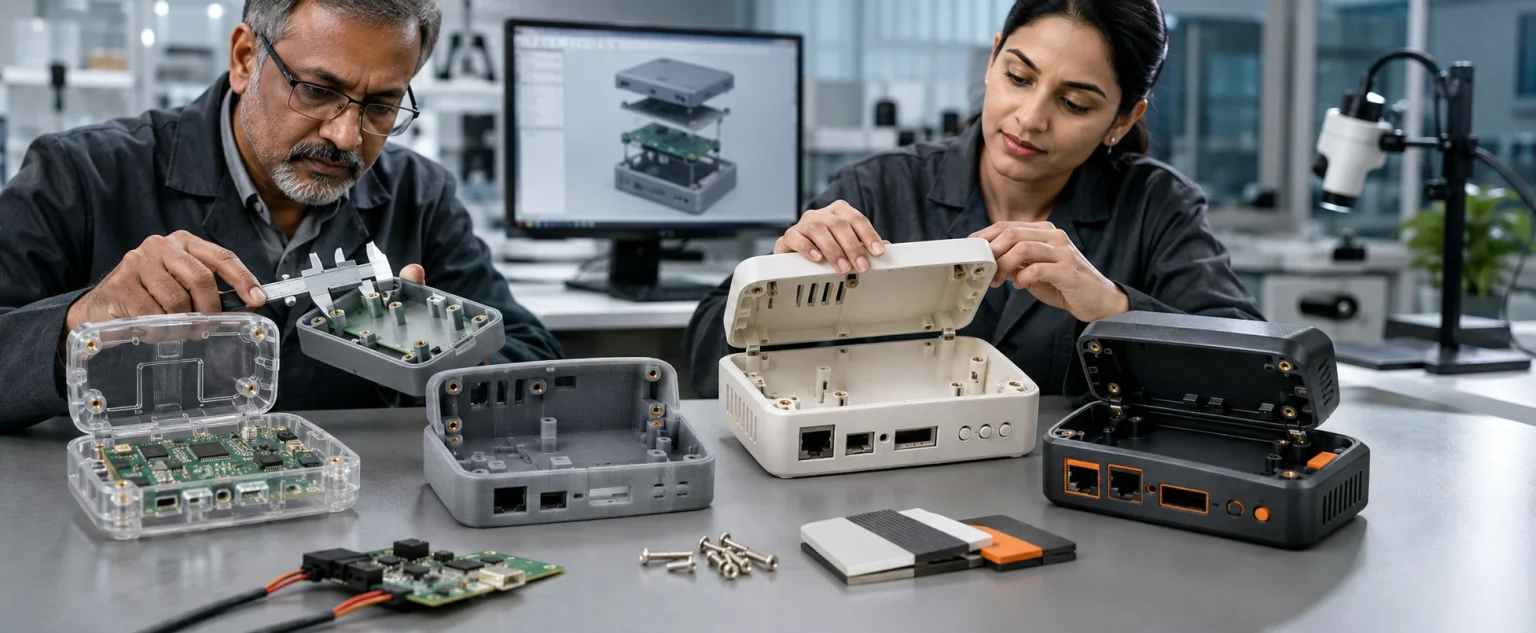
Noida electronics teams can approve an enclosure visually while missing PCB, port, boss and cable problems that appear only during physical assembly. A structured prototype avoids transferring those issues into tooling. This article explains how 3D printing services in Noida should be evaluated from the customer-problem, engineering-decision and commercial-buyer perspectives. It also shows what information should be shared with a professional manufacturing partner so the quotation, process and final part are aligned with the real project objective.
An electronics enclosure may look complete in CAD while still containing risks around PCB clearance, connector access, screw engagement, heat, cable routing and assembly. Discovering these problems after tooling can delay launch and increase cost. Functional nylon components, fixtures and complex geometries may be suitable for SLS 3D printing.
Quick Answer
3D printing services in Noida is most useful when it is selected around a real engineering and commercial objective. Buyers should connect design maturity, geometry, material behaviour, quantity, finish, inspection and commercial risk instead of selecting a process only by unit price. A detailed brief makes quotations more comparable and helps the manufactured part answer the question it was created to test.
Why Enclosure Prototyping Matters
- Catching internal architecture problems before tooling avoids expensive late changes.
- A CAD model can look complete while hiding PCB clearance, connector access, screw engagement, heat, cable routing and assembly risks.
- Physical prototypes validate external interfaces such as ports, buttons, screens, indicators and mounting features.
- Fastening and closure testing confirms the enclosure can be opened and closed repeatedly without cracking or losing alignment.
- Discovering problems after tooling delays launch and increases cost.
Where Excel Rapidtech Fits
Excel Rapidtech's 3D printing services in Noida can support enclosure development from initial fit checks to functional prototypes and small repeated batches before injection moulding. Excel Rapidtech can review the CAD model, application, quantity, material expectation, finish and critical dimensions before recommending a suitable route. The company's wider service structure allows projects to be considered across 3D printing, SLA, SLS, vacuum casting, CNC machining, design support and post-processing rather than being forced into one method.
Comparison
The following factors should be reviewed together. Optimising one in isolation can create a new problem elsewhere in the project.
| Decision area | Option or condition A | Option or condition B |
|---|---|---|
| PCB supports | Height, flatness and insertion path | |
| Ports | Alignment, finger clearance and cable access | |
| Screw bosses | Wall thickness, pilot hole and tightening | |
| Snap-fits | Engagement, strain and material behaviour | |
| Vents | Physical clearance and separate thermal validation |
Step-by-Step Workflow
- Define the business decision the part must support. Examples include design approval, fitment validation, customer trial, tooling release or a limited pilot batch.
- Identify the technical risks. Mark interfaces, critical dimensions, loads, environmental exposure, visible surfaces and features that may fail during assembly.
- Select the process around those risks. Compare geometry, material behaviour, quantity, finish and design stability rather than choosing only by familiarity or lowest price.
- Agree on acceptance criteria. State what will be measured, assembled, tested or visually approved before the part is accepted.
- Control revisions and approvals. Use a clear file number, record feedback and freeze the approved version before the next manufacturing stage.
Before the decision framework, prototype these areas on the part itself:
- Prototype the internal architecture: check PCB position, component height, battery space and cable paths using the actual electronics where possible. A transparent or sectioned prototype may help the engineering team inspect internal relationships.
- Validate external interfaces: check ports, buttons, screens, indicators and mounting features, confirming that fingers, tools and cables can access the product as intended.
- Test fastening and closure: review screw bosses, snap-fits, clips, hinges and joining surfaces.
- Separate thermal and mechanical conclusions: assess vent placement and physical space with the printed prototype, but run thermal analysis and testing separately when heat is critical.
Common Mistakes to Avoid
- Using only the nominal PCB outline.
- Ignoring connector plugs and cable strain.
- Placing bosses too close to walls.
- Assuming vents prove thermal performance.
- Finishing the model before fit issues are closed.
What to Measure
- PCB and component envelope, defined in measurable terms.
- Connector and button access, defined in measurable terms.
- Boss and snap-fit design, defined in measurable terms.
- Vent and heat-zone clearance, defined in measurable terms.
- Assembly and service sequence, defined in measurable terms.
- What to include in the brief: CAD, PCB model, interface drawing, quantity, finish, critical dimensions and intended test, plus whether the sample is for internal engineering, customer approval or a pilot batch.
How to Choose a Professional 3D Printing Process
The best process depends on what the prototype must prove. SLA is commonly selected when fine details and a smooth surface are important. SLS is often preferred for complex nylon parts, clips and functional assemblies. Vacuum casting may follow a finished master when several similar polymer parts are required. CNC machining may be more appropriate where the design, material or tolerance is better served by subtractive manufacturing. A professional provider should explain the trade-off instead of recommending the same technology for every file.
Factors That Affect Cost and Delivery
Price and lead time are shaped by part size, build volume, orientation, material, quantity, support removal, surface finishing, painting, assembly and inspection. File problems and unclear requirements can cause more delay than the print itself. Buyers should provide a complete technical brief and respond quickly to manufacturability questions. For local projects, proximity can simplify communication and collection, but it does not replace technical planning or quality control.
What to Include in a Quotation Request
Share the preferred file format, quantity, application, target material behaviour, critical dimensions, tolerance where genuinely required, surface finish, colour and delivery requirement. State whether the part is for appearance, fit, assembly, function or a pilot batch. Include drawings and mating components where possible. This reduces ambiguous assumptions and makes supplier quotations easier to compare.
How to Compare Local 3D Printing Suppliers
Compare process range, engineering review, material information, finishing, inspection, confidentiality, revision control and communication. Ask whether the supplier can explain why a process is suitable for the application. Review what is included in the quotation and whether critical dimensions will be checked. A professional service should help reduce project risk, not merely convert file volume into a price.
Conclusion
The right use of 3D printing services in Noida begins with a clearly defined problem and ends with an evidence-based manufacturing decision. Buyers should connect design maturity, geometry, material behaviour, quantity, finish, inspection and commercial risk instead of selecting a process only by unit price. A detailed brief makes quotations more comparable and helps the manufactured part answer the question it was created to test. Share your CAD file, required quantity, application, critical dimensions and finish expectations with Excel Rapidtech for a technical feasibility review.
Ready to discuss your part?
FAQs
Why prototype an enclosure before injection moulding?
An electronics enclosure may look complete in CAD while still containing risks around PCB clearance, connector access, screw engagement, heat, cable routing and assembly. Discovering these problems after tooling can delay launch and increase cost.
What should be included in a prototype brief?
Share the CAD, PCB model, interface drawing, quantity, finish, critical dimensions and intended test. Mention whether the sample is for internal engineering, customer approval or a pilot batch.
Which 3D printing process should be used for enclosure prototypes?
SLA is commonly selected when fine details and a smooth surface are important. SLS is often preferred for complex nylon parts, clips and functional assemblies. Vacuum casting may be useful when several production-like housings are needed, and CNC machining may suit designs better served by subtractive manufacturing.
Does a printed prototype prove thermal performance?
No. A printed prototype can help assess vent placement and physical space, but it does not automatically reproduce the thermal behaviour of the final moulded material. Use appropriate thermal analysis and testing when heat is critical.
What factors affect cost and delivery of 3D printed parts?
Price and lead time are shaped by part size, build volume, orientation, material, quantity, support removal, surface finishing, painting, assembly and inspection. File problems and unclear requirements can cause more delay than the print itself.
What does the step-by-step decision framework cover?
Define the business decision the part must support, identify the technical risks, select the process around those risks, agree on acceptance criteria, and control revisions and approvals before the next manufacturing stage.
Related Reading
- When Should a Product Team Move from Vacuum Casting to Injection Moulding?
- How to Validate PCB Fitment, Ports and Screw Bosses with a 3D-Printed Enclosure
- How Gurgaon Product Companies Can Choose Between SLA and SLS Prototyping
- 3D Printing for Noida Manufacturers: Prototypes, Jigs, Fixtures and Replacement Parts
- How Noida Startups Can Develop a Working Hardware Prototype Before Fundraising or Production