
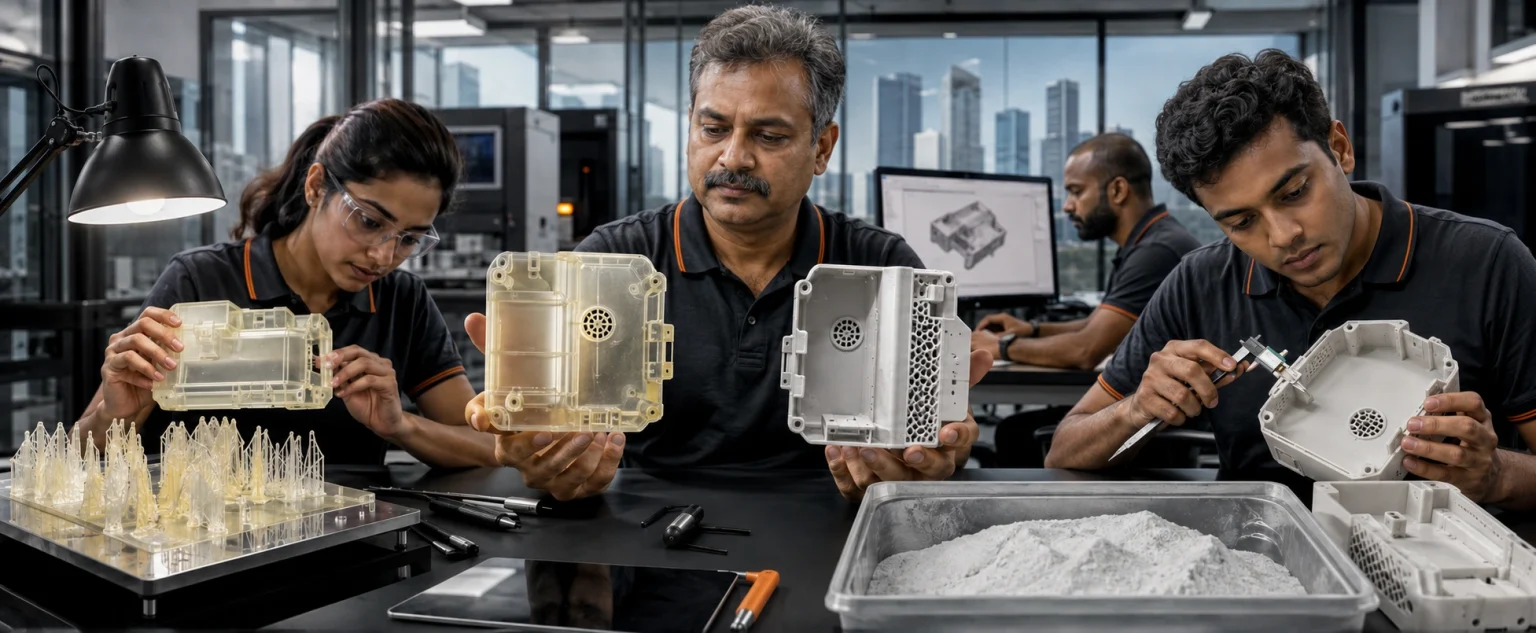
A Gurgaon product team may choose SLA for smooth appearance or SLS for functional nylon, but the decision becomes unreliable when surface, load, geometry and finishing are not prioritised. This article explains how 3D printing in Gurgaon should be evaluated from the customer-problem, engineering-decision and commercial-buyer perspectives. It also shows what information should be shared with a professional manufacturing partner so the quotation, process and final part are aligned with the real project objective.
3D printing in Gurgaon is most useful when it is selected around a real engineering and commercial objective. This guide explains the practical decisions product teams, engineers and procurement teams should make before approving the next manufacturing step.
Quick Answer
SLA and SLS can both create accurate prototypes, but they are typically selected for different priorities. Teams should choose SLA when fine details, smooth surfaces and presentation quality matter, and SLS for functional nylon parts, complex geometry and clips, brackets or moving assemblies — comparing surface, mechanical behaviour, accuracy, critical features and finishing rather than choosing by price alone.
Why Process Selection Matters
- SLA and SLS can both create accurate prototypes, but they are typically selected for different priorities — choosing by price alone can lead to a part that looks impressive but fails the intended test.
- An SLA part may require support removal and selected finishing, while an SLS part commonly has a textured powder-built surface unless it is further processed.
- Not all resin or nylon grades behave the same — review stiffness, impact, flex, heat and repeated use, and plan CAD changes to suit the selected process.
- Identify holes, mating faces, thin walls, snap-fits and text, and discuss expected tolerance and any post-machining or finishing required for critical areas.
- Using different processes for different questions — SLA for appearance, SLS for function — can provide clearer results than forcing one prototype to do everything.
Where Excel Rapidtech Fits
Excel Rapidtech can help Gurgaon product teams compare SLA, SLS and other available routes based on the part's application, quantity and finish rather than a generic technology preference. The company can review the CAD model, application, quantity, material expectation, finish and critical dimensions before recommending a suitable route, with a wider service structure covering 3D printing, SLA, SLS, vacuum casting, CNC machining, design support and post-processing.
Comparison
| Decision area | Option or condition A | Option or condition B |
|---|---|---|
| Typical strength | Detailed visual and selected fit models | Functional nylon components |
| Surface | Smooth with suitable finishing | Naturally textured unless processed |
| Supports | Supports generally required | Powder supports complex geometry |
| Common use | Appearance models and masters | Clips, brackets and assemblies |
| Decision basis | Detail and finish | Function and geometry |
Key Factors
The following factors should be reviewed together. Optimising one in isolation can create a new problem elsewhere in the project.
- Surface-detail requirement. Define the requirement in measurable terms and explain how it affects the intended test, assembly or production decision.
- Mechanical behaviour. Define the requirement in measurable terms and explain how it affects the intended test, assembly or production decision.
- Support and geometry. Define the requirement in measurable terms and explain how it affects the intended test, assembly or production decision.
- Post-processing. Define the requirement in measurable terms and explain how it affects the intended test, assembly or production decision.
- Critical dimensions. Define the requirement in measurable terms and explain how it affects the intended test, assembly or production decision.
Step-by-Step Workflow
- Define the business decision the part must support. Examples include design approval, fitment validation, customer trial, tooling release or a limited pilot batch.
- Identify the technical risks. Mark interfaces, critical dimensions, loads, environmental exposure, visible surfaces and features that may fail during assembly.
- Select the process around those risks. Compare geometry, material behaviour, quantity, finish and design stability rather than choosing only by familiarity or lowest price.
- Agree on acceptance criteria. State what will be measured, assembled, tested or visually approved before the part is accepted.
- Control revisions and approvals. Use a clear file number, record feedback and freeze the approved version before the next manufacturing stage.
Common Mistakes to Avoid
- Assuming SLA is always more accurate.
- Assuming all SLS nylon is identical.
- Ignoring support marks and powder texture.
- Choosing one process for every prototype stage.
- Failing to specify critical tolerances.
What to Measure
- Critical dimensions and expected tolerance for holes, mating faces, thin walls, snap-fits and text.
- Stiffness, impact, flex, heat and repeated use of the selected resin or nylon grade.
- Surface finish against the final visual requirement.
- Support removal and post-processing needs for SLA parts.
- Consistent functional checks repeated across prototype versions.
How to Choose a Professional 3D Printing Process
The best process depends on what the prototype must prove. SLA is commonly selected when fine details and a smooth surface are important. SLS is often preferred for complex nylon parts, clips and functional assemblies. Vacuum casting may follow a finished master when several similar polymer parts are required. CNC machining may be more appropriate where the design, material or tolerance is better served by subtractive manufacturing. A professional provider should explain the trade-off instead of recommending the same technology for every file.
Factors That Affect Cost and Delivery
Price and lead time are shaped by part size, build volume, orientation, material, quantity, support removal, surface finishing, painting, assembly and inspection. File problems and unclear requirements can cause more delay than the print itself. Buyers should provide a complete technical brief and respond quickly to manufacturability questions. For local projects, proximity can simplify communication and collection, but it does not replace technical planning or quality control.
What to Include in a Quotation Request
Share the preferred file format, quantity, application, target material behaviour, critical dimensions, tolerance where genuinely required, surface finish, colour and delivery requirement. State whether the part is for appearance, fit, assembly, function or a pilot batch. Include drawings and mating components where possible. This reduces ambiguous assumptions and makes supplier quotations easier to compare.
How to Compare Local 3D Printing Suppliers
Compare process range, engineering review, material information, finishing, inspection, confidentiality, revision control and communication. Ask whether the supplier can explain why a process is suitable for the application. Review what is included in the quotation and whether critical dimensions will be checked. A professional service should help reduce project risk, not merely convert file volume into a price.
Conclusion
The right use of 3D printing in Gurgaon begins with a clearly defined problem and ends with an evidence-based manufacturing decision. Buyers should connect design maturity, geometry, material behaviour, quantity, finish, inspection and commercial risk instead of selecting a process only by unit price. A detailed brief makes quotations more comparable and helps the manufactured part answer the question it was created to test. Share your CAD file, required quantity, application, critical dimensions and finish expectations with Excel Rapidtech for a technical feasibility review.
Ready to discuss your part?
FAQs
When is SLA prototyping suitable?
SLA is often considered when fine details, smooth surfaces and presentation quality are important. It can be useful for visual models, detailed housings and master patterns that will be finished or used in a secondary process.
When is SLS prototyping suitable?
SLS is often considered for functional nylon parts, complex geometry and components such as clips, brackets or moving assemblies. Because the powder supports the build, complex shapes may be produced without conventional support structures.
Can SLA and SLS be used together in one project?
Yes. For a new product, teams may use SLA for appearance review and SLS for functional testing. Selecting different processes for different questions can provide clearer results than forcing one prototype to do everything.
How do SLA and SLS surfaces compare?
An SLA part may require support removal and selected finishing. An SLS part commonly has a textured powder-built surface unless it is further processed. The final visual requirement should be included in the quotation.
What should teams compare when choosing between SLA and SLS?
Compare typical strength, surface, supports, common use and decision basis: detail and finish versus function and geometry. Do not assume that all resin or nylon grades behave the same — review stiffness, impact, flex, heat and repeated use.
Should the decision be based on price?
No. Choosing by price alone can lead to a part that looks impressive but fails the intended test. SLA and SLS can both create accurate prototypes, but they are typically selected for different priorities.
Related Reading
- 3D Printing Services in India: SLA vs SLS vs MJF vs DLP
- Which 3D Printing Technology Should You Choose? A Guide for Engineers
- How Gurgaon Automotive Teams Can Prototype Components Before Production Tooling
- 3D Printing Services in India: Cost, Lead Time and RFQ Checklist
- 3D Printing Companies in India: 12 Capabilities Engineering Teams Should Compare