
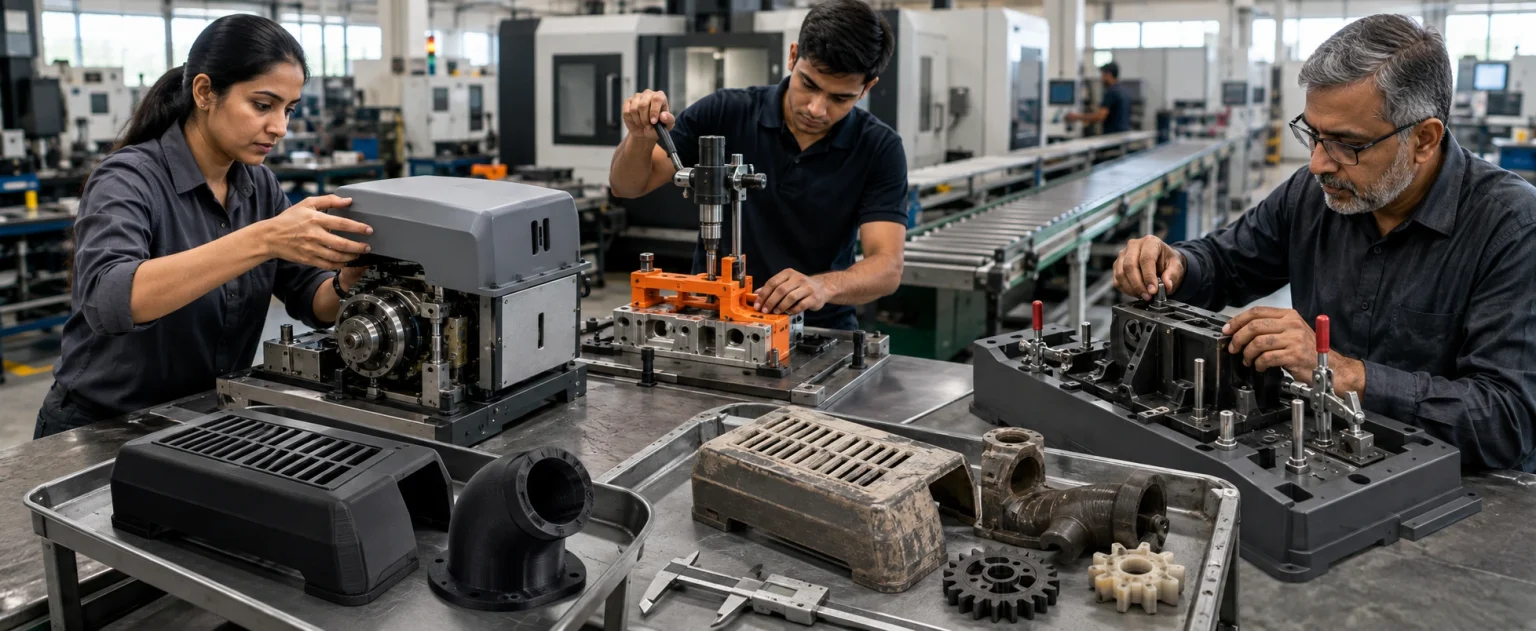
Manufacturers often view 3D printing only as a design-office tool, while production aids, gauges and low-volume replacement parts may deliver equal or greater operational value. This article explains how 3D printing in Noida should be evaluated from the customer-problem, engineering-decision and commercial-buyer perspectives. It also shows what information should be shared with a professional manufacturing partner so the quotation, process and final part are aligned with the real project objective.
Manufacturers can use additive processes across product development, production support and maintenance. The business case depends on lead time, quantity, geometry and the cost of downtime or conventional tooling. Functional nylon components, fixtures and complex geometries may be suitable for SLS 3D printing.
Quick Answer
3D printing in Noida is most useful when it is selected around a real engineering and commercial objective. Industrial 3D printing is not limited to product models: it also covers jigs and fixtures, inspection gauges, replacement and obsolete parts, and low-volume custom parts. The right process and material depend on application, not just part dimensions.
Why Industrial 3D Printing Matters
- Production aids, gauges and low-volume replacement parts can deliver equal or greater operational value than design-office prototypes.
- Printed jigs and fixtures can position components, support assembly, guide drilling or simplify inspection.
- Inspection gauges help teams verify position, clearance or profile during production.
- Replacement and obsolete parts can be recreated when a non-critical plastic component is unavailable.
- Additive manufacturing supports variants, custom brackets, covers and specialised equipment components where conventional tooling is difficult to justify.
- The business case depends on lead time, quantity, geometry and the cost of downtime or conventional tooling.
Where Excel Rapidtech Fits
Excel Rapidtech's 3D printing services in Noida can support engineering teams with prototypes, production aids and low-volume components. A technical review can help determine where additive manufacturing provides real value. Excel Rapidtech can review the CAD model, application, quantity, material expectation, finish and critical dimensions before recommending a suitable route. The company's wider service structure allows projects to be considered across 3D printing, SLA, SLS, vacuum casting, CNC machining, design support and post-processing rather than being forced into one method.
Comparison
| Decision area | Option or condition A | Option or condition B |
|---|---|---|
| Prototype | Design and assembly validation | |
| Jig | Positioning or guiding an operation | |
| Fixture | Holding a part consistently | |
| Gauge | Checking a feature against a defined limit | |
| Replacement part | Restoring a non-critical function in low quantity |
Step-by-Step Workflow
- Product prototypes: create physical parts to review form, fit, assembly and selected functional features before investing in production processes. Use each prototype to answer a documented question.
- Jigs and fixtures: design printed aids to position components, support assembly, guide drilling or simplify inspection. Design them around operator comfort, load, wear and the expected number of cycles.
- Inspection gauges: use simple checking tools to help teams verify position, clearance or profile during production. Critical gauges should be validated against the required measurement standard.
- Replacement and obsolete parts: when a non-critical plastic component is unavailable, recreate a replacement from drawings, CAD or measured geometry. Review safety, load and liability before using printed parts in machinery.
- Low-volume custom parts: use additive manufacturing for variants, custom brackets, covers and specialised equipment components where conventional tooling is difficult to justify.
- Process and material selection: match the process and finishing to the application — a smooth visual prototype, a durable fixture and a transparent cover may require different processes. The service brief should focus on application rather than only the part's dimensions.
Common Mistakes to Avoid
- Using prototype material in a safety-critical application.
- Designing a fixture without operator input.
- Treating a printed gauge as calibrated automatically.
- Ignoring wear surfaces.
- Reproducing an obsolete part without understanding its function.
What to Measure
- Process load and cycle count, defined in measurable terms.
- Operator ergonomics, defined in measurable terms.
- Measurement requirement, defined in measurable terms.
- Downtime cost, defined in measurable terms.
- Safety and criticality, defined in measurable terms.
- What to include in a quotation request: preferred file format, quantity, application, target material behaviour, critical dimensions, tolerance where genuinely required, surface finish, colour and delivery requirement, plus drawings and mating components where possible.
How to Choose a Professional 3D Printing Process
The best process depends on what the prototype must prove. SLA is commonly selected when fine details and a smooth surface are important. SLS is often preferred for complex nylon parts, clips and functional assemblies. Vacuum casting may follow a finished master when several similar polymer parts are required. CNC machining may be more appropriate where the design, material or tolerance is better served by subtractive manufacturing. A professional provider should explain the trade-off instead of recommending the same technology for every file.
Factors That Affect Cost and Delivery
Price and lead time are shaped by part size, build volume, orientation, material, quantity, support removal, surface finishing, painting, assembly and inspection. File problems and unclear requirements can cause more delay than the print itself. Buyers should provide a complete technical brief and respond quickly to manufacturability questions. For local projects, proximity can simplify communication and collection, but it does not replace technical planning or quality control.
A Step-by-Step Decision Framework
- Define the business decision the part must support. Examples include design approval, fitment validation, customer trial, tooling release or a limited pilot batch.
- Identify the technical risks. Mark interfaces, critical dimensions, loads, environmental exposure, visible surfaces and features that may fail during assembly.
- Select the process around those risks. Compare geometry, material behaviour, quantity, finish and design stability rather than choosing only by familiarity or lowest price.
- Agree on acceptance criteria. State what will be measured, assembled, tested or visually approved before the part is accepted.
- Control revisions and approvals. Use a clear file number, record feedback and freeze the approved version before the next manufacturing stage.
How to Compare Local 3D Printing Suppliers
Compare process range, engineering review, material information, finishing, inspection, confidentiality, revision control and communication. Ask whether the supplier can explain why a process is suitable for the application. Review what is included in the quotation and whether critical dimensions will be checked. A professional service should help reduce project risk, not merely convert file volume into a price.
Conclusion
The right use of 3D printing in Noida begins with a clearly defined problem and ends with an evidence-based manufacturing decision. Buyers should connect design maturity, geometry, material behaviour, quantity, finish, inspection and commercial risk instead of selecting a process only by unit price. A detailed brief makes quotations more comparable and helps the manufactured part answer the question it was created to test. Share your CAD file, required quantity, application, critical dimensions and finish expectations with Excel Rapidtech for a technical feasibility review.
Ready to discuss your part?
FAQs
What can industrial 3D printing be used for beyond product prototypes?
Manufacturers can use additive processes across product development, production support and maintenance: product prototypes, jigs and fixtures, inspection gauges, replacement and obsolete parts, and low-volume custom parts. The business case depends on lead time, quantity, geometry and the cost of downtime or conventional tooling.
What is the difference between a jig and a fixture?
A jig is used for positioning or guiding an operation, while a fixture holds a part consistently during an operation.
Are 3D-printed inspection gauges automatically calibrated?
No. A printed gauge should not be treated as calibrated automatically. Critical gauges should be validated against the required measurement standard.
Can obsolete parts be reproduced with 3D printing?
When a non-critical plastic component is unavailable, a replacement may be recreated from drawings, CAD or measured geometry. Review safety, load and liability before using printed parts in machinery.
What should the service brief focus on for jigs and fixtures?
A smooth visual prototype, a durable fixture and a transparent cover may require different processes and finishing. The service brief should focus on application rather than only the part's dimensions.
What engineering factors should be evaluated for production aids?
Process load and cycle count, operator ergonomics, measurement requirement, downtime cost, and safety and criticality. The factors should be reviewed together because optimising one in isolation can create a new problem elsewhere.
Related Reading
- How Delhi Manufacturers Can Reduce Product Development Time with Rapid Prototyping
- 3D Printing Services in India: Cost, Lead Time and RFQ Checklist
- 3D Printing Companies in India: 12 Capabilities Engineering Teams Should Compare
- How Noida Electronics Companies Can Prototype Enclosures Before Injection Moulding
- Which 3D Printing Technology Should You Choose? A Guide for Engineers