
A team needs multiple polymer parts and is unsure whether to print each one directly or invest in a master and silicone mould. The wrong route can create avoidable finishing cost or delay revisions. This article explains how vacuum casting should be evaluated from the customer-problem, engineering-decision and commercial-buyer perspectives. It also shows what information should be shared with a professional manufacturing partner so the quotation, process and final part are aligned with the real project objective.
Vacuum casting is most useful when it is selected around a real engineering and commercial objective. This guide explains the practical decisions product teams, engineers and procurement teams should make before approving the next manufacturing step.
Why Both Processes May Be Relevant
Project-specific feasibility, material and quantity questions can be shared through the Excel Rapidtech contact page.
Direct 3D printing and vacuum casting are often used in the same product-development programme. The first process can create a master or functional prototype quickly, while the second can reproduce multiple similar parts from a silicone mould. The challenge is deciding when direct printing should continue and when casting becomes the better route.
Choose Direct 3D Printing When the Design Is Changing
If the geometry is still being revised, printing each version can be more efficient because no mould needs to be remade. It is also useful when every part is different, when quantity is very low or when the selected printing technology already provides the required mechanical behaviour.
Choose Vacuum Casting When Consistency and Finish Matter
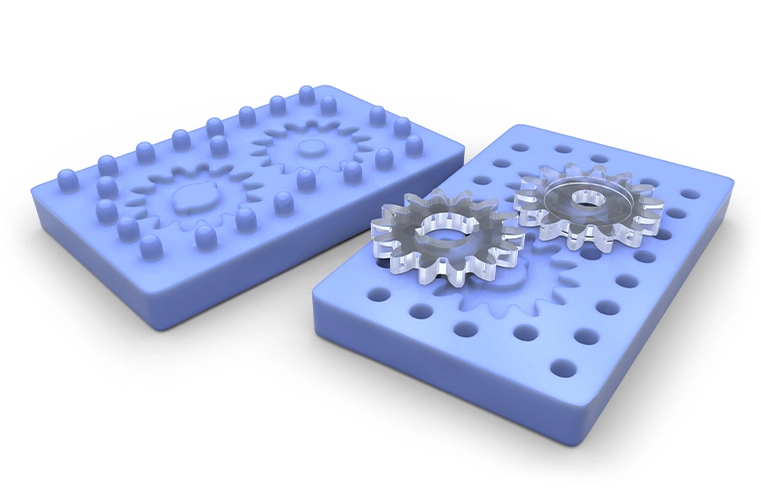
Vacuum casting can become attractive when the design is stable and several nearly identical polymer parts are required. A prepared master pattern helps establish the surface quality, while the mould allows repeated casting. It may be suitable for product samples, pilot batches, exhibitions and controlled field trials.
Compare the Full Workflow
For direct printing, review print preparation, supports, build orientation and post-processing. For vacuum casting, review the master pattern, silicone mould, casting resin, colour, curing and finishing. A process that appears faster at the machine stage may require more finishing before the part is usable.
Material Behaviour
A printed nylon component, a rigid resin master and a polyurethane casting can behave differently even if their dimensions are similar. The selection must therefore begin with what the part needs to do: flex, carry load, resist impact, look transparent, accept paint or reproduce a fine texture.
Quantity Is Important but Not the Only Factor
There is no universal quantity at which vacuum casting automatically becomes better. Geometry, finish, material, mould life and design stability affect the answer. Ten complex cosmetic parts may justify casting, while fifty functional components may still be better produced through an additive process.
How to Request a Useful Comparison
Share the CAD file, total quantity, required delivery date, material expectations, colour, critical dimensions and intended test. Ask the service provider to explain both the engineering suitability and the cost structure of each route.
How Excel Rapidtech Can Help
Because Excel Rapidtech works across 3D printing and vacuum casting, the project can be evaluated without forcing every requirement into one process. The recommended route should reflect the design stage and the commercial objective of the batch.
Key Engineering Factors to Evaluate
For a detailed overview of the manufacturing route, review Excel Rapidtech's vacuum casting services.
The following factors should be reviewed together. Optimising one in isolation can create a new problem elsewhere in the project.
- Design stability. Define the requirement in measurable terms and explain how it affects the intended test, assembly or production decision.
- Number of identical parts. Define the requirement in measurable terms and explain how it affects the intended test, assembly or production decision.
- Surface finish. Define the requirement in measurable terms and explain how it affects the intended test, assembly or production decision.
- Material behaviour. Define the requirement in measurable terms and explain how it affects the intended test, assembly or production decision.
- Need for part-to-part consistency. Define the requirement in measurable terms and explain how it affects the intended test, assembly or production decision.
Practical Comparison Framework
| Decision area | Option or condition A | Option or condition B |
|---|---|---|
| Design changes | Easy to update file and reprint | Usually requires a new or modified master/mould |
| Identical quantity | Strong for very low quantities | Useful for repeated similar parts |
| Surface | Depends on process and finishing | Copies the prepared master surface |
| Material choice | Printing-specific materials | Casting resins that simulate selected behaviours |
| Workflow | Direct manufacture | Master, mould, casting and finishing |
How the Complete Vacuum Casting Workflow Affects the Result
The process begins before resin is poured. CAD review determines whether undercuts, thin walls and trapped regions are suitable. The master pattern establishes geometry and surface quality. Silicone mould planning controls the split, gates and vents. Material preparation, vacuum handling, cure and demoulding then determine whether the copy is complete and stable. Finally, trimming, finishing and inspection convert the casting into an approved part. A weakness at any stage can appear as a dimensional, cosmetic or delivery problem later. Buyers should therefore evaluate the workflow as an integrated chain rather than treating casting as a single machine operation.
Cost and Lead-Time Drivers That Should Be Discussed Early
Cost is influenced by master-pattern production, surface preparation, mould complexity, number of moulds, resin, colour, finishing, inspection and approved quantity. Lead time is affected by CAD clarification, master approval, silicone curing, trial castings and any rework required before the batch begins. Urgent projects benefit from a complete brief and fast approval process, not from skipping controls. The quotation should state assumptions so both parties understand what will change the price or schedule.
Information to Share with the Service Provider
When the design is still changing, compare this route with professional 3D printing services in India before committing to a batch process.
Provide a STEP file where possible, the required approved quantity, the purpose of the parts, colour and finish expectations, critical dimensions, mating components and the planned test environment. Identify cosmetic faces and areas where flash or a parting line would be unacceptable. State whether the batch is for internal engineering, customer trials, an exhibition or limited sale. This context allows the provider to plan the master, mould and inspection standard around the actual outcome.
How to Evaluate a Vacuum Casting Quotation
Check whether the quotation includes the master, master finishing, silicone moulds, trial pieces, approved parts, colour, post-processing and dimensional inspection. Ask how mould replacement will be handled if the first mould does not support the whole batch. Confirm what constitutes an acceptable part and how rejected pieces affect quantity. A lower price can reflect fewer finishing or inspection steps, so compare scope rather than only totals.
A Step-by-Step Decision Framework
- Define the business decision the part must support. Examples include design approval, fitment validation, customer trial, tooling release or a limited pilot batch.
- Identify the technical risks. Mark interfaces, critical dimensions, loads, environmental exposure, visible surfaces and features that may fail during assembly.
- Select the process around those risks. Compare geometry, material behaviour, quantity, finish and design stability rather than choosing only by familiarity or lowest price.
- Agree on acceptance criteria. State what will be measured, assembled, tested or visually approved before the part is accepted.
- Control revisions and approvals. Use a clear file number, record feedback and freeze the approved version before the next manufacturing stage.
Common Mistakes to Avoid
- Choosing by quantity alone.
- Ignoring finishing time for direct prints.
- Creating a mould before the geometry is stable.
- Assuming casting resin equals printed nylon.
- Comparing quotes that include different finishing levels.
How Excel Rapidtech Can Support the Project
High-detail masters and visual prototypes may be produced through SLA 3D printing when the geometry and surface requirement are suitable.
Excel Rapidtech can review the CAD model, application, quantity, material expectation, finish and critical dimensions before recommending a suitable route. For this topic, the primary commercial resource is the vacuum casting page at https://excelrapidtech.com/services/vacuum-casting/. The company's wider service structure also allows relevant projects to be considered across 3D printing, SLA, SLS, vacuum casting, CNC machining, design support and post-processing rather than being forced into one method.
The recommendation should remain factual and project-specific. Final tolerance, material performance, mould yield, delivery and compliance depend on the approved design, selected material, process plan and documented acceptance criteria. These points should be confirmed during technical review and quotation.
Conclusion
Functional nylon components and complex unsupported shapes may be evaluated through SLS 3D printing for relevant applications.
The right use of vacuum casting begins with a clearly defined problem and ends with an evidence-based manufacturing decision. Buyers should connect design maturity, geometry, material behaviour, quantity, finish, inspection and commercial risk instead of selecting a process only by unit price. A detailed brief makes quotations more comparable and helps the manufactured part answer the question it was created to test. Share your CAD file, required quantity, application, critical dimensions and finish expectations with Excel Rapidtech for a technical feasibility review.
Ready to discuss your part?
FAQs
When should I choose direct 3D printing over vacuum casting?
When the geometry is still being revised, every part is different, quantity is very low, or the selected printing technology already provides the required mechanical behaviour.
When is vacuum casting the better route?
When the design is stable and several nearly identical polymer parts are required with consistent finish, such as product samples, pilot batches, exhibitions and controlled field trials.
How does surface finish compare between the two routes?
Direct printing depends on the process and finishing, while vacuum casting copies the prepared master surface.
Is vacuum casting always better above a certain quantity?
No. Geometry, finish, material, mould life and design stability affect the answer: ten complex cosmetic parts may justify casting, while fifty functional components may still be better produced through an additive process.
Do printed nylon and cast resin behave the same?
No. A printed nylon component, a rigid resin master and a polyurethane casting can behave differently even if their dimensions are similar, so selection should begin with what the part needs to do.
What should I share to get a useful comparison?
The CAD file, total quantity, required delivery date, material expectations, colour, critical dimensions and intended test.
Related Reading
- Vacuum Casting vs Injection Moulding: Which Process Is Better for Your First 100 Parts?
- How Many Parts Can Be Produced from One Vacuum Casting Silicone Mould?
- When Should a Product Team Move from Vacuum Casting to Injection Moulding?
- How to Prepare a Master Pattern for Accurate Vacuum-Cast Parts
- Can Vacuum-Cast Parts Be Used for Functional Testing and Customer Trials?