
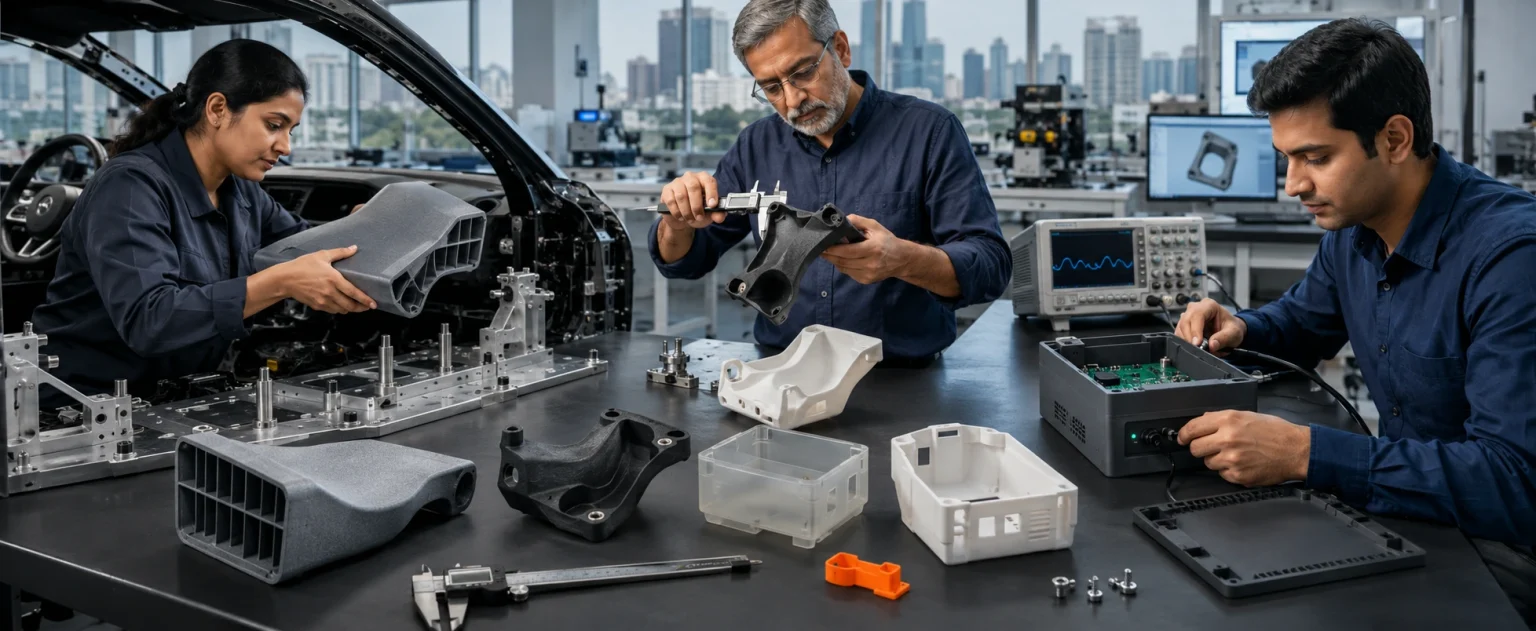
Automotive and electronics assemblies contain many interfaces that are difficult to judge on screen. Late discovery of interference, port misalignment or tool-access issues can hold up tooling and validation. This article explains how industrial 3D printing in Delhi should be evaluated from the customer-problem, engineering-decision and commercial-buyer perspectives. It also shows what information should be shared with a professional manufacturing partner so the quotation, process and final part are aligned with the real project objective.
Industrial 3D printing in Delhi is most useful when it is selected around a real engineering and commercial objective. This guide explains the practical decisions product teams, engineers and procurement teams should make before approving the next manufacturing step.
Quick Answer
Delhi automotive and electronics companies use 3D printing for product validation by prototyping brackets, housings, ducts, covers, clips, ergonomic components, enclosures and jigs or fixtures — confirming mounting points, tool access, interference, assembly sequence, PCB clearance and port alignment before tooling, and iterating quickly as tests reveal issues.
Why Product Validation Matters
- Automotive and electronics projects involve assemblies, connectors, fasteners and confined spaces — a digital model is essential, but a physical prototype can reveal issues that are difficult to judge on screen.
- Teams can prototype brackets, housings, ducts, covers, clips and ergonomic components to confirm mounting points, tool access, interference and assembly sequence before tooling.
- Printed enclosures help check PCB clearance, port alignment, screw bosses, vents, cable routing and battery access, with cosmetic approval separated from thermal and long-term material testing.
- Manufacturing teams can use printed jigs and fixtures for positioning, drilling, inspection or assembly, designed around the operator, process load and expected number of cycles.
- When a test reveals an issue, the CAD can be revised and another part produced without waiting for a full production tool — the value comes from learning early and documenting each revision.
Where Excel Rapidtech Fits
Excel Rapidtech's 3D printing services in Delhi can support validation from the first physical model through functional prototypes and pilot-ready components, depending on the project requirement. The company can review the CAD model, application, quantity, material expectation, finish and critical dimensions before recommending a suitable route, with a wider service structure covering 3D printing, SLA, SLS, vacuum casting, CNC machining, design support and post-processing.
Comparison
| Decision area | Option or condition A | Option or condition B |
|---|---|---|
| Automotive bracket | Mounting, interference and service access | |
| Duct or cover | Routing, clearance and attachment | |
| Electronics housing | PCB, ports, vents and bosses | |
| Jig or fixture | Operator use and process load | |
| Display sample | Finish, colour and stakeholder approval |
Key Factors
The following factors should be reviewed together. Optimising one in isolation can create a new problem elsewhere in the project.
- Assembly sequence. Define the requirement in measurable terms and explain how it affects the intended test, assembly or production decision.
- Component clearance. Define the requirement in measurable terms and explain how it affects the intended test, assembly or production decision.
- Connector access. Define the requirement in measurable terms and explain how it affects the intended test, assembly or production decision.
- Surface and ergonomic review. Define the requirement in measurable terms and explain how it affects the intended test, assembly or production decision.
- Process-specific material limits. Define the requirement in measurable terms and explain how it affects the intended test, assembly or production decision.
Step-by-Step Workflow
- Define the business decision the part must support. Examples include design approval, fitment validation, customer trial, tooling release or a limited pilot batch.
- Identify the technical risks. Mark interfaces, critical dimensions, loads, environmental exposure, visible surfaces and features that may fail during assembly.
- Select the process around those risks. Compare geometry, material behaviour, quantity, finish and design stability rather than choosing only by familiarity or lowest price.
- Agree on acceptance criteria. State what will be measured, assembled, tested or visually approved before the part is accepted.
- Control revisions and approvals. Use a clear file number, record feedback and freeze the approved version before the next manufacturing stage.
Common Mistakes to Avoid
- Testing components in isolation.
- Ignoring cable bend radius.
- Using a visual resin for repeated clips.
- Failing to include actual fasteners.
- Making unverified claims from prototype tests.
What to Measure
- Mounting points, tool access, interference and assembly sequence with actual fasteners.
- PCB clearance, port alignment, screw bosses, vents, cable routing and battery access on printed enclosures.
- Cable bend radius respected in routing.
- Jig and fixture loading against the expected number of cycles.
- Surface finish, colour and stakeholder approval on display samples, with cosmetic approval kept separate from thermal and long-term material testing.
How to Choose a Professional 3D Printing Process
The best process depends on what the prototype must prove. SLA is commonly selected when fine details and a smooth surface are important. SLS is often preferred for complex nylon parts, clips and functional assemblies. Vacuum casting may follow a finished master when several similar polymer parts are required. CNC machining may be more appropriate where the design, material or tolerance is better served by subtractive manufacturing. A professional provider should explain the trade-off instead of recommending the same technology for every file.
Factors That Affect Cost and Delivery
Price and lead time are shaped by part size, build volume, orientation, material, quantity, support removal, surface finishing, painting, assembly and inspection. File problems and unclear requirements can cause more delay than the print itself. Buyers should provide a complete technical brief and respond quickly to manufacturability questions. For local projects, proximity can simplify communication and collection, but it does not replace technical planning or quality control.
What to Include in a Quotation Request
Share the preferred file format, quantity, application, target material behaviour, critical dimensions, tolerance where genuinely required, surface finish, colour and delivery requirement. State whether the part is for appearance, fit, assembly, function or a pilot batch. Include drawings and mating components where possible. This reduces ambiguous assumptions and makes supplier quotations easier to compare.
How to Compare Local 3D Printing Suppliers
Compare process range, engineering review, material information, finishing, inspection, confidentiality, revision control and communication. Ask whether the supplier can explain why a process is suitable for the application. Review what is included in the quotation and whether critical dimensions will be checked. A professional service should help reduce project risk, not merely convert file volume into a price.
Conclusion
The right use of industrial 3D printing in Delhi begins with a clearly defined problem and ends with an evidence-based manufacturing decision. Buyers should connect design maturity, geometry, material behaviour, quantity, finish, inspection and commercial risk instead of selecting a process only by unit price. A detailed brief makes quotations more comparable and helps the manufactured part answer the question it was created to test. Share your CAD file, required quantity, application, critical dimensions and finish expectations with Excel Rapidtech for a technical feasibility review.
Ready to discuss your part?
FAQs
Why use 3D printing for product validation?
Automotive and electronics assemblies contain many interfaces that are difficult to judge on screen. Late discovery of interference, port misalignment or tool-access issues can hold up tooling and validation. A physical prototype can reveal issues that a digital model cannot.
What automotive parts can be prototyped?
Teams can prototype brackets, housings, ducts, covers, clips and ergonomic components. The objective may be to confirm mounting points, tool access, interference and assembly sequence before tooling.
What can a printed electronics enclosure validate?
Printed enclosures can help check PCB clearance, port alignment, screw bosses, vents, cable routing and battery access. Separate cosmetic approval from thermal and long-term material testing.
How are jigs and fixtures used in manufacturing?
Manufacturing teams may use printed aids for positioning, drilling, inspection or assembly. These parts should be designed around the operator, process load and expected number of cycles.
How fast is design iteration with 3D printing?
When a test reveals an issue, the CAD can be revised and another part produced without waiting for a full production tool. The value comes from learning early and documenting each revision.
What should buyers compare when selecting a 3D printing service in Delhi?
Buyers should compare technical review, material options, finishing, inspection, confidentiality and delivery — not only price per cubic centimetre. Ask for clarity on what is included in the quotation.
Related Reading
- How Gurgaon Automotive Teams Can Prototype Components Before Production Tooling
- How Delhi Manufacturers Can Reduce Product Development Time with Rapid Prototyping
- How to Validate PCB Fitment, Ports and Screw Bosses with a 3D-Printed Enclosure
- How Noida Electronics Companies Can Prototype Enclosures Before Injection Moulding
- 3D Printing for Noida Manufacturers: Prototypes, Jigs, Fixtures and Replacement Parts